
SHare
Five insights for healthcare communicators from the Reddit Health Summit
Last week, Reddit brought healthcare leaders together at One World Trade Center for its Reddit Health Summit. The statistics were impressive: billions of views of healthcare conversations, nearly 1,000 health-focused communities and a significant presence among U.S. physicians.
But the bigger story wasn’t Reddit’s scale. It was what the platform reveals about how people increasingly make health decisions.
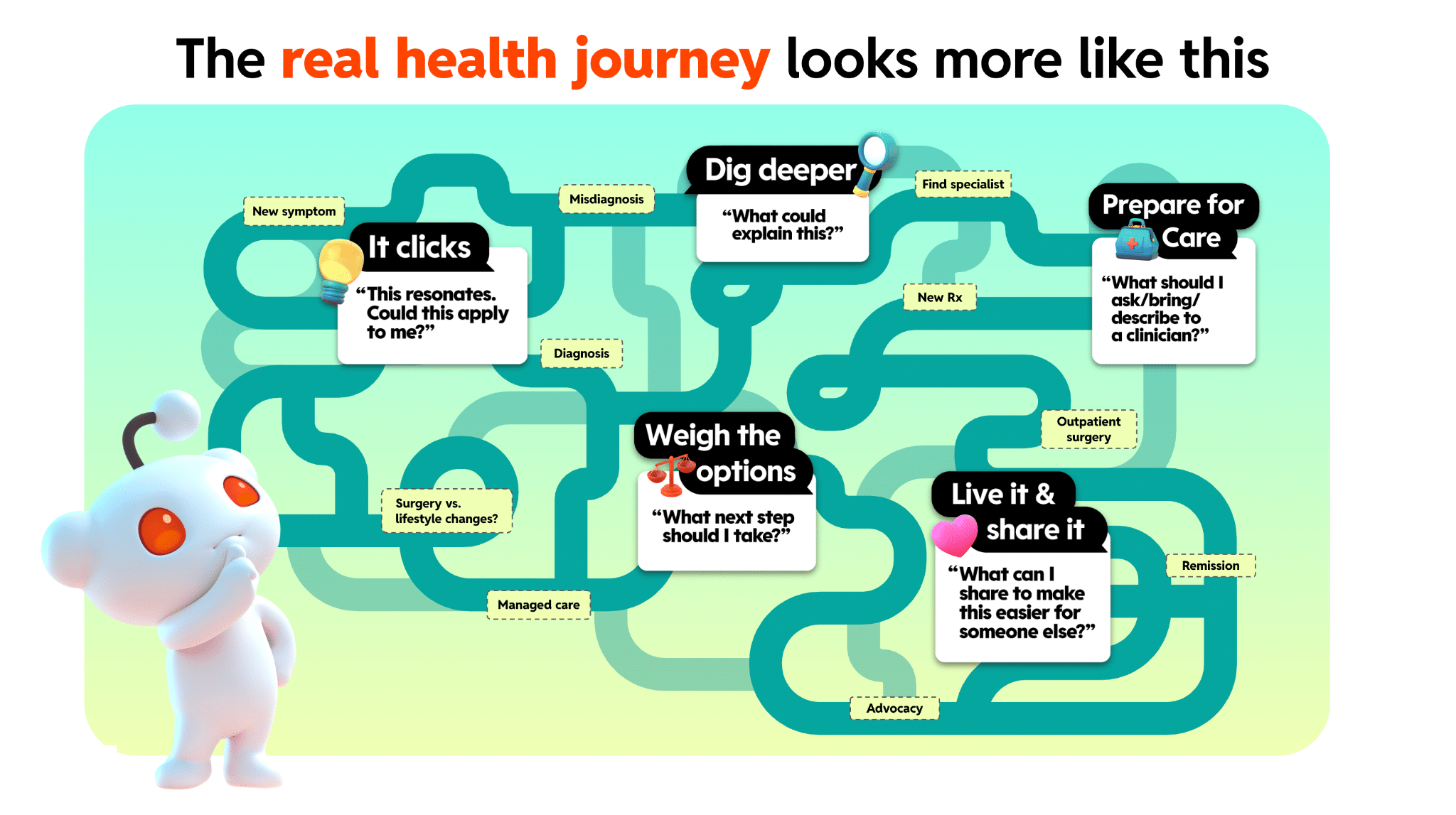
Patients don’t move neatly from awareness to education to physician conversation to treatment. They encounter someone else’s experience. They recognize something in themselves. They investigate. They compare. They ask AI. They validate what they learn with other people. They prepare for a physician conversation. They make a decision.
Then many come back and tell others what happened.
The patient becomes part of someone else’s journey.
For healthcare communicators, that leads to five important strategic shifts.
1. Think community before media
Healthcare marketers have traditionally started with an audience, a message and a media plan.
Reddit suggests reversing the order.
Start by understanding the community.
What are people already discussing? What questions recur? Where are they confused? What language do they use? Whom do they trust? What information is missing?
Health communities can be unusually intentional and curated. Members and moderators value both evidence and lived experience. Brands entering those environments without understanding their norms risk behaving like outsiders who have interrupted a conversation.
The strategic shift is simple:
Don’t start by asking, “Where should we advertise?” Start by asking, “What does this community need?”
Listen first. Understand the information gaps. Determine what the organization can credibly contribute. Then decide whether—and how—the brand should participate.
Community strategy should precede media strategy.
2. Think education before promotion
This leads directly to one of the biggest opportunities discussed at the Summit: unbranded education.
Patients have questions about symptoms, diagnosis, treatment pathways, side effects, affordability, insurance coverage, adherence and what to expect next.
The opportunity is to identify persistent information gaps and ask:
What does this audience need to understand that nobody is adequately explaining today?
An organization that credibly answers that question can create value before it ever promotes a product.
That is particularly important in healthcare, where trust needs to be earned before an advertisement is likely to be persuasive.
3. Think networks, not funnels
Perhaps the most important implication is that the traditional patient funnel is becoming less useful.
Recognition can precede intention. Someone reads another person’s experience and thinks, Could this be me?
Research may lead to AI, then Reddit, then a physician, then back to Reddit. Treatment decisions can trigger new searches about affordability or side effects. And patients who reach the end of one journey often return to the beginning of someone else’s by sharing what happened to them.
Historically, healthcare organizations have concentrated on the beginning of this pathway: evidence and physician interpretation.
Increasingly, communicators need to understand the entire network.
That means looking beyond disease-specific communities as well.
Caregivers may be discussing health in parenting, aging or entertainment communities. Women may be talking about symptoms and diagnostic experiences in gender- or life-stage communities rather than disease-specific ones.
Patients don’t organize their lives according to health categories.
Our communications strategies shouldn’t assume they do.
4. Think conversation change, not just media performance
If communities are influencing health decisions, our definition of communications effectiveness also needs to expand.
Reach, engagement, click-through rates and conversions remain important. But they measure what happened to the content.
Healthcare communicators should increasingly measure what happened to the conversation.
Did the questions people asked change? Did an information gap begin to close? Did new terminology emerge? Did people become better prepared to speak with healthcare professionals? Did the community begin discussing an issue differently?
This creates an important distinction:
Media KPIs measure the performance of communications. Conversation KPIs can help measure their impact on understanding.
That is a potentially powerful new measurement layer for healthcare communications.
5. Think about the AI afterlife of every conversation
AI makes all four of these shifts more consequential.
People increasingly ask AI systems questions about their health and then turn to communities to validate what they were told.
A Reddit conversation isn’t necessarily confined to Reddit. Human discussions can become source material that search engines and AI systems use to formulate future answers that show up in a summary answer to a ChatGPT, Gemini or Claude request.
That means community narratives can acquire an AI afterlife.
A patient’s description of a side effect, an insurance problem or a treatment experience may help shape what another person encounters later when asking an AI system a related question.
The strategic question is no longer simply:
“What are people saying about our disease or product?”
It becomes:
“What are patients teaching one another—and which of those lessons could AI carry forward?”
That is a fundamentally different communications question.
A new role for healthcare communications
Taken together, these shifts suggest that Reddit is increasingly part of a broader information ecosystem through which people interpret health.
Patients are becoming researchers, comparators, validators and publishers of their own experiences. Communities are helping transform individual experiences into collective knowledge. AI can then synthesize and redistribute that knowledge at enormous scale.
That creates both opportunity and responsibility for healthcare organizations. The response shouldn’t simply be to put more advertising into these environments.
It should be to become better listeners and better educators.
Community before media.
Education before promotion.
Networks instead of funnels.
Conversation impact alongside media performance.
And AI as an amplifier of what communities collectively learn.
These lessons about Reddit point toward a larger change in healthcare communications.
The patient journey is becoming a living information network in which evidence, professional expertise, lived experience, community validation and artificial intelligence continually interact.
For healthcare communicators, the opportunity is not simply to participate in that network.
It is to make the network more useful, accurate and understandable for the people who depend on it.
TJ Echeverria, Tiffany Rutkowski, Chad Hyett and Bob Pearson